Secure Grok Google Calendar Connection with PortEden
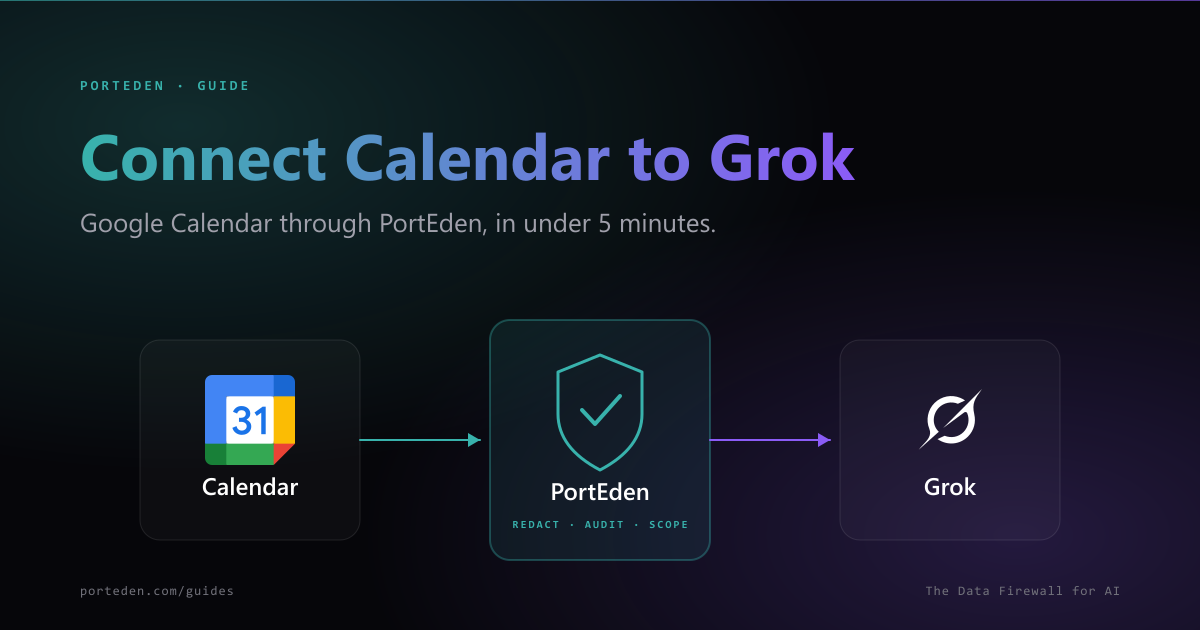
This guide sets up a secure Grok and Google Calendar connection using PortEden as the data firewall. You add one Custom MCP URL in Grok, sign in, and Grok can read events, look up free/busy windows, and (optionally) create or update meetings through scoped permissions. Attendee names and email addresses are redacted before they reach xAI, and every tool call is recorded in the PortEden audit log. No prior PortEden signup needed.
In short
- Start in Grok. Add one Custom MCP URL:
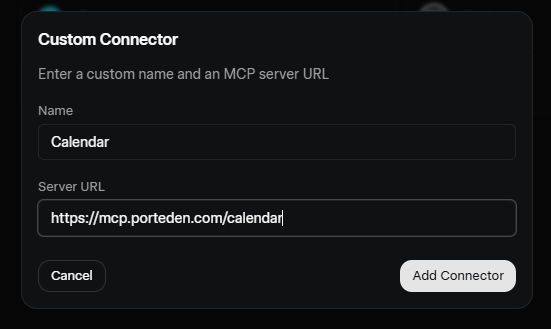
https://mcp.porteden.com/calendar - PortEden's auth window opens. Sign in or sign up in one click. No prior PortEden setup required.
- If Google Calendar is already connected to your PortEden account, the authorization step is skipped automatically.
- Verify with a read prompt. Tighten permissions, redaction, and contact rules later from my.porteden.com.
What you get
When the connection is live, Grok can answer scheduling questions and (with the right permissions) take action on your calendar. Every tool call routes through PortEden, which applies:
Event search and read
Query by date range, attendee, subject, or location. Read titles, descriptions, locations, and attendee lists with redaction.
Free/busy lookup
Check availability across your own calendars or other people's, when their free/busy is shared with you. Useful for finding meeting slots.
Event create, update, delete
Create meetings, reschedule, change attendees, add Google Meet links, or cancel. Confirm-before-write is on by default for destructive actions.
Audit trail
Every tool call from Grok is logged: the requested action, the decision (allow, redact, or block), and the response shape returned. SIEM-exportable.
Prerequisites
- A Grok account at grok.com on a plan that supports Connectors and Custom MCP.
- A Google account with Calendar access. You will authorize it during the flow if your PortEden account does not already have Google connected.
No PortEden account yet? That is fine.
Step 1: Add the PortEden MCP Connector in Grok
Start in Grok. PortEden runs a hosted MCP server you can connect with one URL. Nothing to install, nothing to deploy.
Connector values
| Field | Value |
|---|---|
| Connector name | Google Calendar |
| MCP server URL | https://mcp.porteden.com/calendar |
| Authentication | OAuth (handled by PortEden) |
Step 2: Sign in to PortEden
When Grok enables the connector, it opens a PortEden auth window. This is the single setup screen you will see.
What the token looks like
Step 3: Connect Google Calendar (first-time only)
This step runs only if your PortEden account does not already have Google connected. If it does, PortEden reuses the existing connection and you jump to Step 4.
If Google is not connected yet
If Google is already connected to PortEden
You will not see a Google authorization prompt at all. PortEden detects the existing connection, attaches it to the new Grok token, and returns you to Grok in a couple of seconds.
Workspace accounts
calendar.readonly, plus calendar.events if Grok will create or modify events. See the Google OAuth Setup guide for a custom OAuth app.Step 4: Verify the connection
Open a new Grok chat and run a low-risk read prompt. Then check the PortEden audit log to confirm the request shows up.
Try one of these
What to confirm
- Grok returns real events from your Google Calendar, not a refusal or an error.
- Attendee email addresses appear redacted or tokenized if you left redaction enabled.
- The PortEden audit log at my.porteden.com shows the request with a green allow decision.
No data yet? Ask Grok to introspect
list_events, search_events, get_freebusy, and create_event.Step 5: Tighten what Grok can do (optional)
The token PortEden created in Step 2 already uses conservative defaults: calendar scope only, attendee email redaction on, and confirm-before-write for create, update, and delete. Once the connection works end-to-end, you can tighten or relax it from my.porteden.com under Access Tokens.
Permission presets for Grok
Pick the action set that matches what you want Grok to do
| Preset | What Grok can do | What it cannot do |
|---|---|---|
| read_only | List, search, and read events; check free/busy | Create, update, delete, or invite |
| read_and_freebusy (default) | Read events plus query free/busy across calendars | Modify events |
| read_and_create | Read plus create new events with attendees | Delete or modify existing events |
| full_calendar | All event actions including delete and recurring updates | Touch other PortEden capabilities (email, drive) |
Recommended rules for a Grok token
- Attendee redaction: Leave on. PortEden tokenizes attendee email addresses by default; Grok still sees who is invited but not where to reach them.
- Calendar scope: Limit Grok to the primary calendar, or specify a list. Personal calendars often hold sensitive titles.
- Time window: A rolling 30 to 60 day window is enough for most assistant tasks. Avoid granting all-history access.
- Contact blocklist: Add board members, legal contacts, or therapists you do not want Grok touching.
- Confirm before write: Keep on for delete and update. Optional for create if you trust the workflow.
Changes apply immediately
Suggested prompts for everyday use
Once verified, these prompts are good starting points. Each maps to a single PortEden tool call, so behavior is predictable and the audit log stays clean.
"Summarize my day. Group meetings into focus blocks, syncs, and externals."
"Find three free 30-minute slots next week between 10am and 4pm, excluding Fridays."
"Move my 3pm Thursday meeting with the design team to 11am Friday. Confirm before sending the update."
"List my recurring meetings, how often they meet, and the total hours per week they take."
"Do I have any back-to-back meetings tomorrow with no break? If yes, propose a 15-minute buffer."
"Schedule a 30-minute kickoff next Tuesday at 2pm with the engineering list. Title: "Q3 planning". Confirm before sending."
Troubleshooting and error handling
PortEden returns structured errors that Grok surfaces in its replies. Match the message to the table below.
Grok cannot reach the PortEden MCP server
Symptoms
- Grok says "I could not reach the connector" or "Custom MCP server unavailable".
- No request appears in the PortEden audit log.
Checks
- Confirm the MCP URL in the Grok Custom Connector is exactly https://mcp.porteden.com/calendar.
- Make sure the connector is Enabled in your Grok workspace, not just Saved.
- Check Grok's connector status page for any global xAI incident.
Debug prompt for Grok
PortEden auth window did not appear
Symptoms
- You enabled the connector in Grok but no PortEden sign-in window opened.
- The connector stays in a Pending or Needs auth state.
Checks
- Allow pop-ups for grok.com in your browser, then click Enable on the connector again.
- Close any duplicate Grok tabs so the auth callback finds the right window.
- Open my.porteden.com in another tab and sign in there first.
Debug prompt for Grok
403 Permission denied on a specific event or action
Symptoms
- Grok says "I do not have permission to do that" or returns an accessInfo string explaining the rejection.
- Audit log shows a block decision with a rule name.
Checks
- Open the Access Token in PortEden and confirm the action Grok tried (e.g. create_event, delete_event) is in the permission set.
- Check the calendar scope. A token limited to the primary calendar will deny requests against a secondary one.
- Look at the time window. Requests outside the allowed window are blocked.
- Adjust the token, save, then ask Grok to retry.
Debug prompt for Grok
Grok did not specify single instance vs series
Symptoms
- An update or delete on a recurring meeting fails with a recurring_target_required error.
- Audit log shows the request was blocked because the target (single, future, or all) was not specified.
Checks
- Ask Grok to clarify which instance or which scope the change applies to.
- Re-run the request with explicit language like 'this Friday's instance only' or 'this and all future occurrences'.
- If you want Grok to default to single instance, set the recurring_default option on the token in PortEden.
Debug prompt for Grok
429 Too Many Requests or quota exceeded
Symptoms
- Bursts of tool calls start failing after the first few succeed.
- Audit log shows rate_limited or quota_exceeded entries.
Checks
- Check your PortEden plan limits at my.porteden.com.
- Spread bursty work over time, or ask Grok to batch (e.g. list a week of events in one call instead of per-day).
- Google Calendar API also throttles per project. PortEden surfaces Google 403 rateLimitExceeded errors with a graph_throttled flag.
Debug prompt for Grok
Google returned reauth required
Symptoms
- Calls were working, then all Calendar tool calls start failing.
- Audit log shows a provider_reauth_required entry.
Checks
- Open Connections in PortEden. Google will show a yellow Needs reauth badge.
- Click Reconnect and complete the Google OAuth flow again. This usually follows a password change or a Google security event.
Debug prompt for Grok
Debug prompts for Grok
When something is wrong but the error message is vague, paste one of these prompts into Grok. They make Grok self-report the structured response from PortEden so you can pinpoint the cause without leaving the chat.
Pair every debug prompt with the audit log
Security best practices
One token per AI per use case. Do not reuse a token across Grok, Claude, and ChatGPT. Per-AI tokens let you revoke just the one that misbehaves.
Start with read_and_freebusy and add create or delete only after you trust the workflow.
Keep attendee email redaction on. Grok still sees who is in the meeting, just not their address. Useful for assistant tasks, safer for sharing.
Restrict to your primary calendar unless Grok genuinely needs the others. Personal calendars (medical, family) usually do not belong in an AI workflow.
Keep Confirm-before-write on for delete. Cancelling a meeting by mistake is loud and painful.
Review the audit log weekly. Filter by the Grok token to see what events were inspected and what changes were attempted.
FAQ
Do I need a PortEden account before I start?
No. Start in Grok. When you add the PortEden MCP URL as a Custom Connector and Grok opens the auth window, you can sign up at that moment with Google one-click or with email. If you already have an account, it signs you in instead.
I already have a PortEden account with Google Calendar connected. Do I need to reauthorize?
No. PortEden detects your existing Google connection during the Grok auth flow and skips the OAuth step automatically. Grok comes back to the chat ready to use.
Can Grok see multiple calendars?
Yes. By default PortEden exposes the primary calendar plus any secondary calendars the user has access to. You can scope a token to a specific calendar list from my.porteden.com if you want Grok limited to just one.
Can Grok create or move events on my behalf?
Yes, if you grant the create or update permissions in the token. Confirm-before-write is on by default for create, update, and delete, so Grok surfaces a preview before any change.
What about recurring meetings?
Grok can read recurring events including instances. To modify a recurring meeting, Grok must specify whether the change applies to a single instance, all future occurrences, or the whole series. PortEden enforces this distinction and the audit log records which mode was used.
Does Grok see free/busy for other people?
Only when the other person has shared their free/busy with you through Google. PortEden does not bypass Google's sharing rules. If the data is not in your view, it is not in Grok's.
Next steps
Connect Gmail to Grok
Pair Calendar with Gmail so Grok can both find slots and follow up by email.
PortEden for Grok
Capabilities, pricing, and deeper architecture notes for using Grok with PortEden.
MCP Calendar tool reference
Every Calendar tool exposed by the PortEden MCP server, with arguments and responses.
Risks of connecting calendar to AI
A regulator-aware look at what can go wrong, and how PortEden mitigates each risk.